October 06, 2026


The question usually shows up halfway down a long descent, when your quads have started negotiating and your toes are jammed against the front of your boots. Below you, someone with two poles is moving like a metronome. Behind you, someone with one tall staff plants it, leans, and swings past, step by step. Both are descending more comfortably than you are, and you're wondering what you left in the car.
Trekking poles and hiking staffs overlap in function, but they aren't interchangeable. One is a pair of adjustable, collapsible tools built to keep your stride balanced and your joints quieter. The other is a single longer stick that trades some of that efficiency for simplicity and a free hand. Which one belongs on your pack depends on where you walk, how heavy your load is, and what your body complains about the day after. Here's how to sort it out.
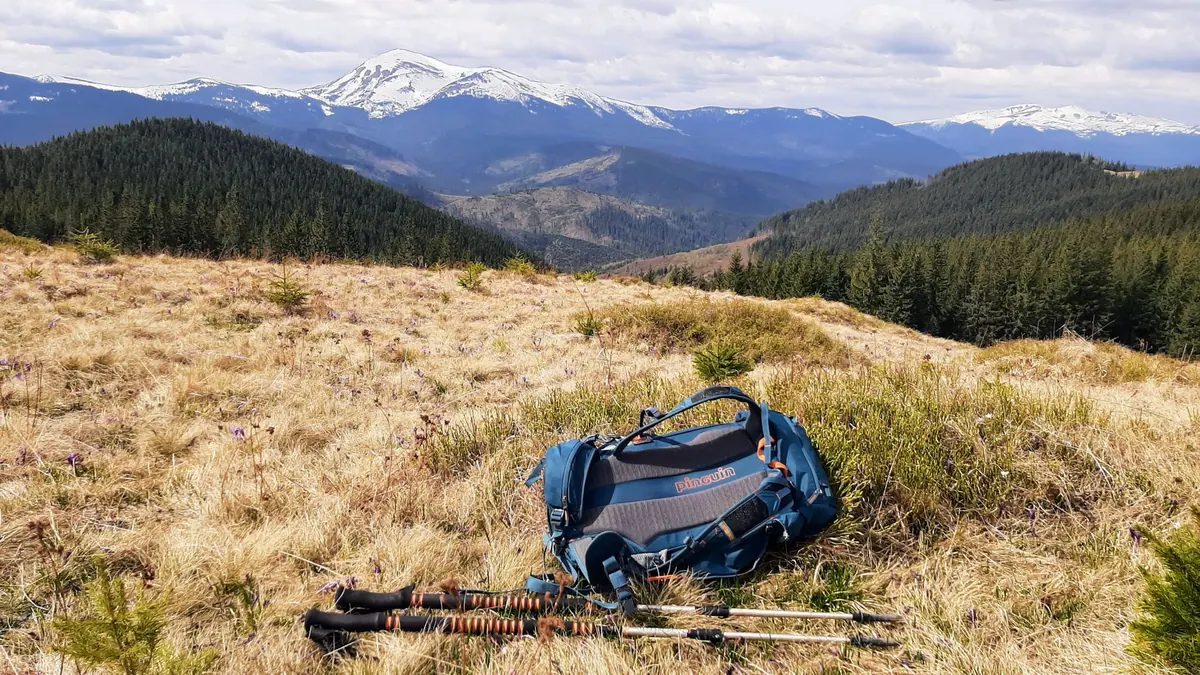
A modern trekking pole is a two- or three-section shaft of aluminum or carbon, adjustable from around chest height down small enough to lash to a pack. It has a grip (cork, foam, or rubber), a wrist strap, a carbide or rubber tip, and usually a small basket that keeps the tip from vanishing into soft ground. Poles are sold and used in pairs, and that pairing does more work than most people expect.
A hiking staff is a single shaft, tall enough that you can rest your palm on the top with your elbow slightly bent. Traditional versions are one-piece wood, sometimes with a carved knob; modern ones collapse and may have a T-grip. You carry it in one hand, plant it, and lean on it when the ground gets steep.
Two poles widen your base of support. Cross a log over a creek and you have three or four points touching down instead of two, which is why hikers with poles often look unnervingly calm on wet rock and off-camber sidehill. When you stumble, a pole gives you something to catch yourself with on either side, not just your dominant hand.
A staff offers a single, very reliable plant. Because you can lean your upper body weight directly over it, it feels like a handrail on sustained steep terrain — a real advantage on a long grind where you're pushing uphill with every step. The trade-off is symmetry: one side does the work, and the other side of your body never gets the same help.
Poles also let you push. Plant both, then drive forward with your arms as your feet move, and your legs do less work on long uphills with a heavy pack.
This is where poles make their strongest case. On a steep descent, every step sends load through your knees, and a pole lets you transfer a share of that load through your arms instead. Two poles spread the benefit across both legs, which matters on a drop that lasts two hours.
Technique decides how much you actually get. Lengthen your poles for descents, shorten them for climbs, and plant the tip before your foot lands, so the pole is already bearing weight when your knee takes the step. A staff helps here too, but mostly on one side, and it works best as a brace — lean on it, step down, repeat — rather than as a rhythmic support.
If you have existing knee trouble, a balance disorder, or recent surgery, treat poles as a tool rather than a treatment and talk to a physical therapist or your doctor about what suits you.
Aluminum poles are the durable, forgiving choice; carbon is lighter but can fail suddenly rather than bending. Either way, a pair collapses to roughly the length of your forearm and disappears onto the side of a pack, into a duffel, or through the loops of a checked bag.
A wooden staff is a different animal. It's a fixed length, it swings around when you scramble, it snags on branches in dense brush, and hardwood versions get genuinely heavy by late afternoon. If you've ever tried to fit a five-foot stick into a small car with three other people and their gear, you know the feeling.
One nice bonus for poles: many lightweight shelters are designed to pitch with two of them, so the weight you carry is doing double duty. A staff can prop a tarp corner or serve as a borrowed walking stick for a tired friend, but it rarely replaces tent hardware.
Buy or borrow before the trip, not during it. Learning to adjust pole length on a steep, wet trail while your friends wait is a nuisance you can skip.
Slip your hand up through the strap from below and let the strap carry the weight across the back of your wrist. Gripping the handle hard for hours is what makes people's forearms ache and conclude that poles aren't for them.
Grip material matters: cork handles sweat well in summer, foam stays warmer in cold and wet. Carbide tips bite into dirt and rock; rubber tips are quieter and kinder on pavement and on heavily used trails. Flick-locks adjust faster with gloves on; twist-locks need more torque but snag less on brush.
Check your poles before a big trip. Wipe grit out of the joints, dry them before storage, and retire any aluminum shaft with a deep bend — a compromised pole can fold under body weight. Keep them out of roles they weren't designed for: they are walking aids, not anchors for a belay or tools for self-arrest on snow.
If you're flying, check your airline's rules well ahead of time. Policies on poles in carry-on vary by carrier and are often stricter than hikers expect.
Match the tool to the walk. If your itinerary is long descents, heavy packs, river crossings, or a body that feels the downhill the next morning, take two poles. If it's brushy,
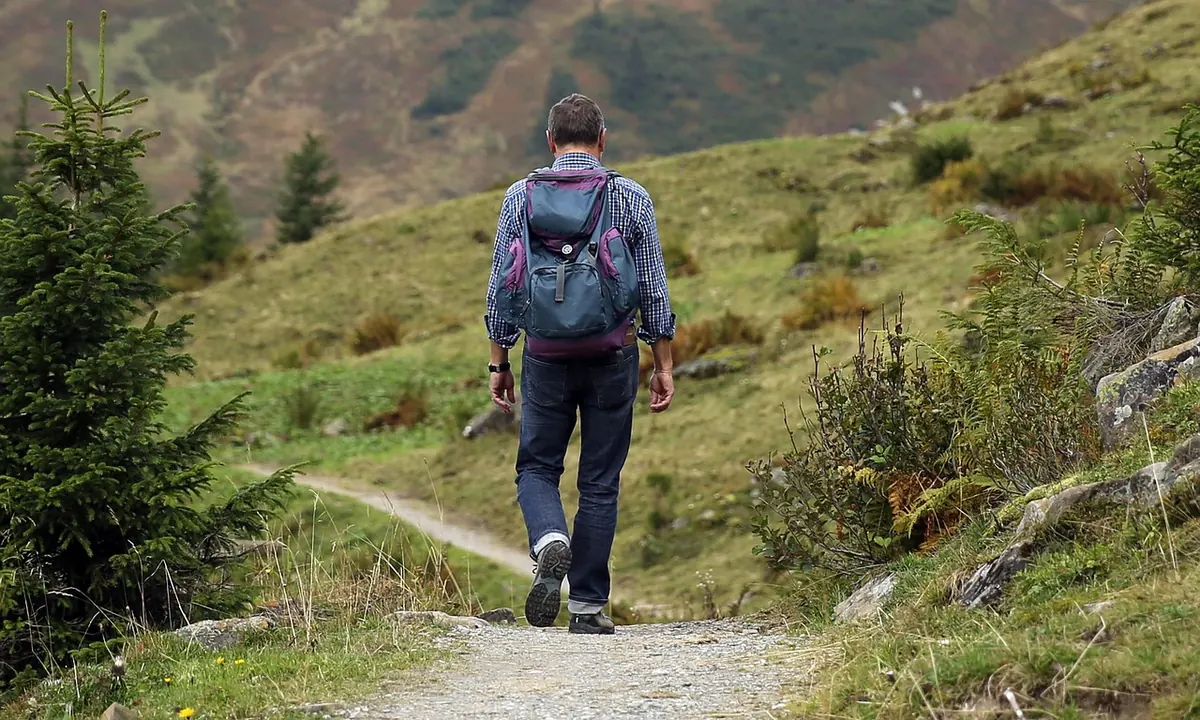
Photo: Viktoriya Zhavruk / Pexels
A guiding light for outdoor adventures..
Copyright © 2026 Briar Beacon. All rights reserved. Briar Beacon.